

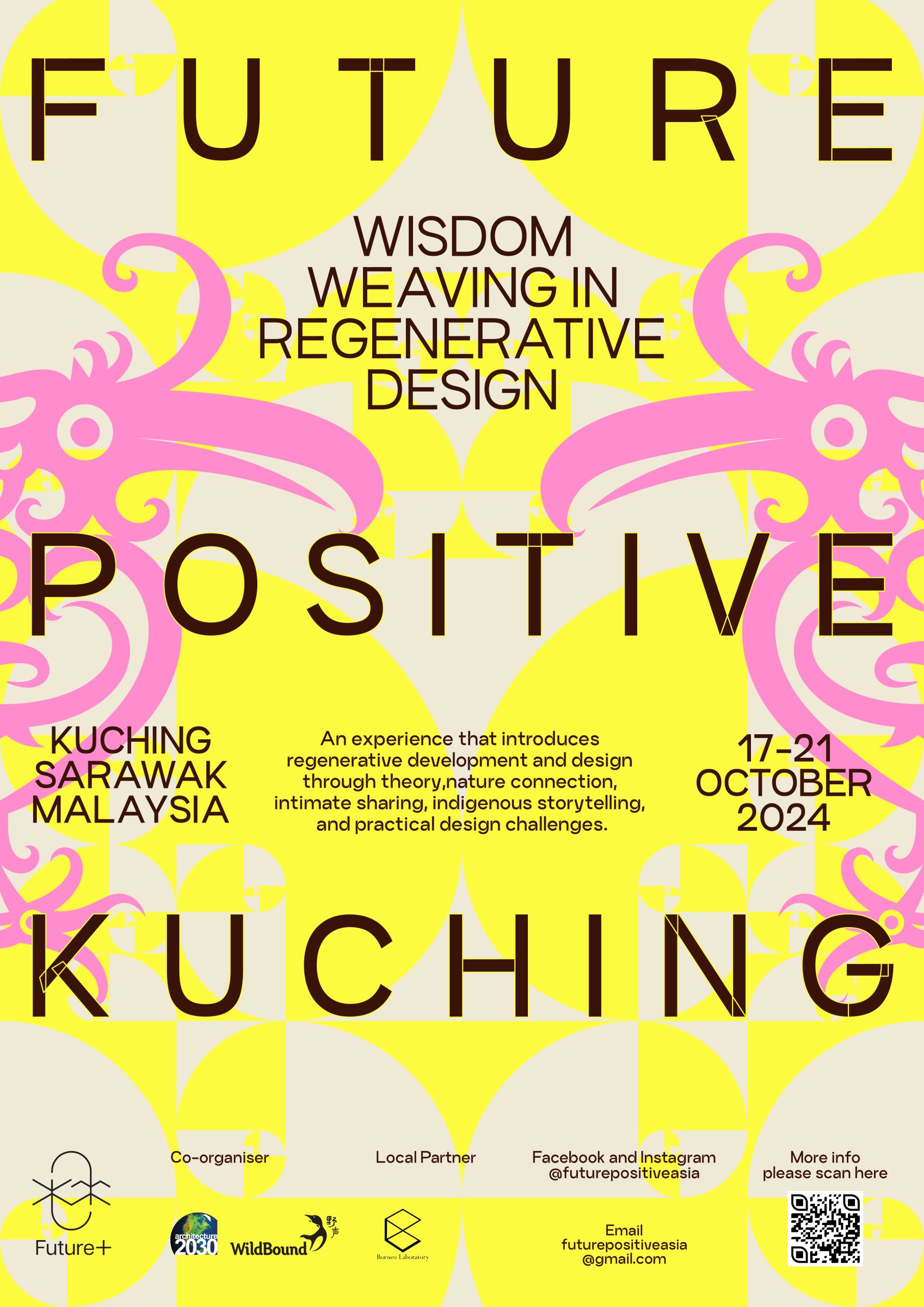
Future+ Kuching: Wisdom Weaving in Regenerative Design
Please scroll down for Chinese version.
Please click the triangle in the paragraph to expand the contents.
Future+ Kuching: Wisdom Weaving in Regenerative Design Video (on Youtube)
Why does the World Need Regenerative Development?
The world is rapidly urbanising. By 2060, the world is projected to add 230 billion square metres (2.5 trillion square feet) of buildings, or an area equal to the entire current global building stock. This is the equivalent of adding an entire New York City to the planet every 34 days for the next 40 years. Globally, the building sector (including building materials) contributes to 40% of total carbon emissions.
Meanwhile, we are consuming an amount of resources way beyond our planetary boundary, 1.8 planet per year to be exact. With the growing needs and wants of an increasingly urbanised population, biodiversity loss is rapidly taking place, with an average decline of 69% in species populations since 1970, and this includes important carbon sinks. From 2001 to 2021, there was a total of 437Mha of tree cover loss globally, equivalent to an 11% decrease in tree cover since 2000 and 176Gt of CO₂ emissions. On top of these ecological challenges are loneliness, addiction, chronic physical and mental health issues, among others.
At the root of these multi-dimensional, systemic challenges is disconnection – from the self, one’s identity, values and beliefs; to the others, family, friends and communities who make up the support network or “village”; to the place, including natural beings such as the land, mountains, rivers, oceans, flora and fauna.
Architects, place designers have an important role to play in addressing these challenges through regenerative development and design, reconnecting seemingly separate elements and beings back into a whole, living, interconnected “interbeing”.
However, conventional, problems-oriented strategies lead to piecemeal results and though with good intentions, are far from sufficient. Technical training to architects and place designers alone falls short of addressing these challenges. Long-lasting, deep changes come not just from the mind, but also from the heart. Regenerative development and design is based on the premise that we can only make the outer transformations required to create a truly sustainable world by making the inner transformations in how we think, how we work and who we are.
Regenerative places are designed with a deep understanding of their innate potential and essence. They are places in alignment with the vitality and wisdom of the natural world. These places strive to go beyond conventional green and sustainable certification, beyond being zero carbon – “do less harm” mitigation, to repairing and creating positive social, ecological, and economic changes in reciprocity with the human and more-than-human world.
What is Regenerative Development and Design?
There is no single definition for regenerative development. The Future+ organising team have studied with and been mentored by faculty members of the Regenesis Institute, whose descriptions we have found to be insightful and practical. Regenerative development is a process or practice that develops the capacity and capability of human and non-human living systems to co-evolve by realising their innate potential. It requires a radical shift in our mindset, acknowledging our roles as enablers and facilitators of whole living systems, breaking boundaries and siloes. Regenerative design emerges from regenerative development. Instead of imposing one’s own ideas and desires onto a place, regenerative design seeks to create products or services in support of the manifestation of the place’s essence and innate potential.
What is Future+?
Future Positive, or Future+, is a programme co-designed by Architecture 2030 and Wildbound, with a mission to enable the emergence of a regenerative architectural and place design hub in Asia. Working in collaboration with our local partners (Mykunda Community in Sichuan, China; Borneo Laboratory in Kuching, Malaysia; Earth Company in Bali, Indonesia), the organising team curate and facilitate multi-day immersive experiences and ongoing mentor and peer support, planting the seeds and nurturing participants to practice and promote regenerative development and design by aligning heads, hearts and hands.
The immersive experiences feature intimate practitioners’ sharing, individual and breakout group exercises, design challenges, connection with nature and place through play, food(!), and meditative movement practices. An emphasis is placed on indigenous history and practices and their connection to the place. The outcome is a deep transformation through reconnecting with the self, others and nature.
The curation and facilitation of Future+ reflect the organising team’s influences, which include: Regenesis Institute, Schumacher College, Deep Ecology, Theory U/ Presencing Institute, Association of Nature and Forest Therapy.
The first immersive experience took place in Sichuan (China) in May 2024, this experience in Kuching (Malaysia), October 2024 will be the second, and Bali (Indonesia) will be hosting the third experience in May 2025.
What Will You Get out of This Programme?
- Ecological wisdom & regenerative design: an understanding of the core principles of regenerative development and design and methods of listening to/ sensing patterns emerging from the land.
- Inner growth and transformation: Experience profound personal growth and inject new energy into your professional career.
- Innovative thinking & transformational perspective: Learn the U Theory framework to enhance your ability to address complex systems.
- Global connections: Join the Future+ network of budding regenerative practitioners and collaborate closely with peers worldwide.
- Hands-on project implementation opportunities: Apply regenerative principles in tangible design projects.
- Professional Certification Credit: Receive a Future+ training certificate and earn credits from the American Institute of Architects (AIA).
- Scholarships to join the Regenesis Institute’s The Regenerative Practitioners Series 5-month training programme.
- 3Fs: Fun. Friendship. (Great) Food!
Our Facilitators

Songqiao Yao
Founder, WildBound
Songqiao Yao is the founder of WildBound, an innovative social enterprise that facilitates experiential education, climate actions, and artistic expression to cultivate sustainability leadership and systems change. Songqiao is also a mindfulness-based coach in training and supports personal and team developments for climate leaders and organizations. Since 2015, Songqiao has participated and led over 16 learning expeditions to the Antarctic Peninsula, the Arctic and the Himalayas.
Prior to founding WildBound, Songqiao was the first Chinese participant and faculty member for Homeward Bound, the largest all-female science and leadership expedition to Antarctica. She is a researcher, activist, and entrepreneur on environmental issues in China and globally. Over the past 10 years, she has led and advised youth climate organizations and projects, worked to conserve China’s rivers as a National Geographic Global Explorer, and consulted on agriculture development projects in Sierra Leone, Ethiopia and Zimbabwe.
In 2024, Songqiao became the first Chinese woman member of the Club of Rome. Songqiao received a Master of Philosophy in Geography from the University of Cambridge as a Gates Scholar and a Master of Business from the University of Oxford as the first Skoll Scholar from China. She graduated summa cum laude from Mount Holyoke College.

Yaki Wo
Asia Lead, Architecture 2030
Born in Hong Kong and having lived in Singapore, Canada and the UK, Yaki has found a new sense of belonging in her second home – Aotearoa New Zealand. She has been deeply influenced by te ao Māori (the Māori worldview) both in her personal and professional life.
Yaki’s diverse human experience ranges from being a mother of two to being a non-profit organisational consultant, facilitator and enabler of deep transformations through connection with and as nature.
As the Asia Lead of Architecture 2030, she set up the organisation’s operations in China in 2015 and facilitated the first buildings private sector commitment to zero carbon, announced at COP21 in Paris. She has been developing and executing Architecture 2030’s Asia strategy to mitigating climate change and regenerating our living system, aligning the Asia programme with its global strategy and building meaningful connections with individuals and organisations.
Yaki is also a certified nature and forest therapy guide with the Association of Nature and Forest Therapy, and an ever-evolving regenerative practitioner with mentors from the Regenesis Institute. She founded Wilderites, a social enterprise that seeks to connect people with the self, others and nature through guided nature therapy walks, circle sharing and immersive experiences.
Her latest passion is the Future Positive Programme, introducing regenerative development and design to architects, planners, place makers, community facilitators and real estate developers in Asia through sensing the land, identifying essence and potential, and supporting the emergence of reciprocal relationships.
In an earlier life Yaki was a programme manager at The Children’s Investment Fund Foundation’s climate team and had managed multi-million, multi-year global climate change mitigation programmes in sustainable cities, air quality, coal consumption control, among others.
Yaki completed her MSc Environment and Development at the London School of Economics, fully funded by the FCO’s Chevening Scholarship.

Wendy Teo
Founder/Curator, Borneo Laboratory
Wendy Teo, a Malaysian-born UK ARB/RIBA Chartered Architect, Curator, Researcher, and Tutor, is dedicated to embedding social-cultural dialogue into design. This commitment defines her professional pursuit. Teo received her B.Arch (Dist.) from Taiwan Feng Chia University and her M.Arch (Dist.) from the Bartlett School of Architecture, UCL. During her tenure at Foster and Partners, she completed her ARB Part III course at Cambridge University and became a LEED Green Associate.
At her multidisciplinary design practice, Wendy Teo Atelier, and her creative agency, Borneo Laboratory, Teo’s work spans architecture, structure, research, and publications. Her projects attempted to impact the social and cultural scenes with critical discourse. Recently, Teo has expanded her research to incorporate regenerative practices inspired by ancestral wisdom and rooted cultural practices.
As the director of Think & Tink, formerly Ting & Ting Supermarket, Teo focuses on transforming this destination into a shared platform for Borneo Laboratory and its regional partners in art, regenerative practices, urban technology, and digital fabrication. The ultimate goal is to cultivate a “mind factory” within the city, encouraging deep thinking and bold actions.
Throughout her career, Wendy Teo’s projects have received international acclaim, including the Holcim Sustainable Next Generation Award (First Prize), Archiprix, and the Threadneedle Prize. Her work has been exhibited globally in the UK, France, Germany, Slovenia, Turkey, and Taiwan. Notably, her projects were featured in the 2013/14 Archilab ‘Naturalising Architecture’ exhibition, curated by Pompidou Center director Frédéric Migayrou and FRAC Orléans Director Marie-Ange Brayer. Wendy Teo is also a recipient of the 2024 Study UK Alumni Award and the 2023 Feng Chia Alumni Award.
What Can You Offer to This Programme?
Reciprocity is a core principle of regenerative development and design. We do not subscribe to hierarchy. We are not teachers lecturing participants as students. Nobody is an “expert” (or, we are all experts in something?). The organising team, guests and participants are gathered to learn from and share with each other the gifts we have. These could be in the form of knowledge, memories, stories, songs, movements, art and craft, food, skills; the list is endless. You are invited to keep this in mind, be aware of and seize the opportunities to make offerings when they are presented to you (there will be many)!
Who is This Programme for?
- Architects, urban designers, rural designers, landscape designers, place designers/ place makers, community facilitators or representatives of local communities, local government, real estate developers, artists, curators, cultural workers, teachers or postgraduate students in Asia.
- Complete beginners in regenerative design to experienced practitioners who wish to deepen their understanding of and embodiment of regenerative design.
- Practitioners who are willing to commit to apply the learnings from Future+ as well as to promote or advocate for regenerative development and design post-programme.
Applicant Requirements:
- Professional background: Applicants should be working architects, planners, place designers/ place makers (community facilitators working on creating places), rural construction practitioners, researchers in these areas, local government or real estate developers and other related practitioners with appropriate practical experience and professional knowledge.
- Language ability: Given the international mentors and participants involved in the workshop, applicants are expected to be able to communicate and listen to lectures in English in order to participate in all activities and discussions.
- Willingness to practice: We expect applicants to put into practice the knowledge and skills they have learnt at the end of the programme, not only to enhance their personal professional abilities, but also to contribute to the growing community and the promotion of regenerative development and design.
Registration
Please register here. This is a link of Google Form and payment via Eventbrite.
The Journey in Kuching

Over the five days from the 17th to the 21st of October (16th October being the arrival day 0), we will be going on a journey together. The tentative programme features elements of self-observation (morning practice, rest/quiet time, and reflections), connection with peers, play (city mapping), nature connection (Fairy Cave), indigenous wisdom sharing, theory (regenerative snippets) and practice (design challenges). There is a theme each day and we are also guided by a set of principles and rituals which will be shared in more detail during the online orientation session.
The following programme is still evolving.
| Day 0 16th Oct |
Day 1 17th Oct |
Day 2 18th Oct |
Day 3 19th Oct |
Day 4 20th Oct |
Day 5 21st Oct |
|
| Theme | Open mind | Open heart | Open will | Open will | ||
| Key words | Care & Kinship | Culture & City | Nature & Indigenous Wisdom | Deep listening | Possibilities | New Beginnings |
| AM | Morning practice/Ice breaker/Introductions/ Regenerative snippets | Morning practice/ Regenerative snippets/ Fairy Cave | Morning practice/ Regenerative snippets/ Individual design challenge | Morning practice/ Group design challenge | Reflections/ Action planning/ Celebration | |
| PM | Arrival | City treasure hunting | Indigenous community visit | Individual design challenge/Group design challenge intro | Group design challenge | |
| Evening | Arrival | Relaxation/Sound bath | Stories sharing | Stories sharing | Plating the wild culinary experience/ Stories sharing |
Typically, our participants experience the following as they embark on this collective journey:
- Reconnect
Through mindfulness practices and nature connection experiences, participants will be supported to establish a deep connection with the self, others and nature.
- Reflect
Deepen your understanding of regenerative development and empathy exercises.
- Reimagine
Find harmony and communion between the inner and outer worlds in silence and reflection, stimulating creative thinking
- Redesign
Practice the application of regenerative design principles, translating new ideas into projects through design challenges and collaborative planning post-workshop.
- Renew
Develop an action plan, commit to a long-term, evolving project, celebrate milestones along the journey, and look to the future.
About Kuching

Kuching, the capital city of Sarawak in Malaysia, is a vibrant and culturally rich destination located on the island of Borneo. Known as the “Cat City,” Kuching is a place where modernity meets tradition, offering a unique blend of historical landmarks, diverse cultures, and stunning natural beauty.
i) Cultural and Historical Significance
Kuching’s history is deeply intertwined with the Brooke family dynasty, which ruled Sarawak as the White Rajahs for over a century. This legacy is visible in many historical buildings and monuments, such as the Astana, Fort Margherita, and the Old Courthouse. The city is also home to the Sarawak Museum, one of the oldest and most comprehensive museums in Southeast Asia, showcasing the region’s rich cultural heritage and natural history. The Borneo Cultures Museum, a new addition, offers state-of-the-art exhibits on Borneo’s diverse cultures and ecosystems, providing a modern complement to the historical displays of the Sarawak Museum.
ii) Kuching Heritage Trail
The Kuching Heritage Trail is a must-explore for visitors interested in the city’s rich past. This self-guided walking tour takes you through Kuching’s historical core, highlighting key landmarks and offering a glimpse into the city’s colonial and indigenous heritage.
Sarawak State Museum The Sarawak State Museum, established in 1891, is one of the oldest and most renowned museums in Southeast Asia. Housed in a grand colonial-era building, the museum boasts extensive collections of ethnographic and natural history artifacts. Visitors can explore exhibits that showcase the diverse cultures of Sarawak’s indigenous peoples, including traditional costumes, tools, and crafts. The museum also features comprehensive displays on the region’s flora and fauna, geological history, and archaeological findings, providing a thorough understanding of Sarawak’s rich biodiversity and cultural heritage.
Borneo Cultures Museum The Borneo Cultures Museum, a modern architectural marvel, is the largest museum in Malaysia and a centerpiece of Kuching’s cultural landscape. Opened in 2020, this state-of-the-art facility offers five floors of interactive and immersive exhibits that celebrate the cultural diversity and natural wonders of Borneo. The museum’s displays are organized thematically, covering topics such as the history and cultures of Borneo’s indigenous groups, traditional and contemporary art, and the island’s unique ecosystems. Highlights include lifelike dioramas, digital installations, and hands-on activities that engage visitors of all ages. The Borneo Cultures Museum serves as a dynamic space for education, cultural exchange, and community engagement, reflecting Sarawak’s commitment to preserving and promoting its heritage.

Other key stops on the heritage trail include the Chinese History Museum, which chronicles the contributions of the Chinese community to Sarawak’s development, and the Islamic Museum, which explores the influence of Islam in the region. Along the trail, you can also visit the Textile Museum, showcasing traditional textiles and weaving techniques, and the Cat Museum, dedicated to all things feline and reflecting the city’s nickname.
iii) Diverse Cultures and Natural Beauty
Kuching is a melting pot of cultures, with a population comprising Dayak, Chinese, Malay and various indigenous groups such as the Iban, Bidayuh, and Orang Ulu. This diversity is reflected in the city’s vibrant festivals, colourful markets, and a wide array of culinary delights. Visitors can explore the bustling streets of Chinatown, enjoy traditional Malay cuisine, or experience the unique flavors of indigenous dishes.

Kuching is surrounded by breathtaking natural landscapes, from lush rainforests and serene rivers to pristine beaches and majestic mountains. The city serves as a gateway to numerous national parks, including Bako National Park, known for its diverse wildlife and stunning coastal scenery, and Gunung Gading National Park, home to the world’s largest flower, the Rafflesia. For those seeking adventure, the nearby Sarawak River offers opportunities for kayaking, river cruises, and cultural village visits.
iv) Sarawak 2030 Smart City Initiatives and Cultural Initiatives
Kuching is at the forefront of Sarawak’s ambitious 2030 Smart City initiatives, aimed at transforming the city into a technologically advanced and sustainable urban center. These initiatives focus on improving the quality of life for residents through the integration of smart technologies in various sectors, including transportation, healthcare, and public services. The introduction of Automated Rapid Transit (ART) is a significant infrastructural development, providing a modern and efficient public transportation system that reduces traffic congestion and promotes sustainable urban mobility. Additionally, the city has invested in various cultural initiatives, including the annual Rainforest World Music Festival and the Kuching Festival, which celebrate local and international arts, music, and cuisine, fostering cultural exchange and community engagement.
Pricing and Rationale
Future+ is a non-profit initiative. Our goal is to create a comprehensive and inclusive experience, ensuring that everyone aspiring to advance the field of sustainable and regenerative design can participate. All revenues received will go towards covering the costs of running the current Programme, as well as the development of the Programme in order to enable more practitioners in Asia to experience inner transformations, and be empowered and supported to practice regenerative design.
You will NOT be denied if you cannot pay. If you have abundant resources, or sponsorship from your workplace however, contributing more than customary rates will enable us to serve more of those who need them.
Our programme price includes:
- Fees for guest sharers, facilitation, venue fees, field trips, course materials and local transportation for the 6-day, 5-night program
- Three meals a day
- Accommodation in a shared room
The price DOES NOT include transportation to and from the programme location.
Choose Your Plan
- Standard Price: 1,100 USD
- This standard rate is aimed at participants who can afford the programme fees. It encompasses the actual cost of the project, the educational value and experience provided, and the necessary resources to ensure the quality of the programme.
- Special Offer: 815 USD
- This discount is available for emerging architects, students, non-profit workers, or architects from low-income regions.
- Full Scholarship: 400 USD deposit (held until the end of the gathering)
- Intended for participants with limited financial means who can offer support and volunteer services.
A deposit of 70 USD is required for all applicants upon enrollement. This deposit will be fully refunded to applicants not selected after the selection process concludes.
Successful applicants will be invited to pay the remaining fees within one week of receiving the notification emails. Full scholarship applicants will have to pay a deposit of 400 USD total (330 USD in addition to the 70 USD paid) which will be held until after the gathering.
By employing this pricing strategy, we aim to attract and encourage architects, planners, designers and other relevant practitioners from various backgrounds to participate in our project, collectively advancing the field of sustainable and regenerative design. We commit to providing a fair and transparent selection process, ensuring every interested and capable practitioner has the opportunity to join our learning journey.
Cancellation Policy
Full refund before 16th September 2024
50% Refund before 2nd October 2024
No Refund after 2nd October 2024
Key Dates
Online info: 2 Sept 7.30pm
Application Deadline: 15 Sept, 2024
Interview Period: 9 – 20 Sept, 2024
Shortlisted Participants Announcement: 13 and 22 Sept, 2024
Additional Note
Rolling admission with a total of 20 spots available. The recruitment will close once full.
For further updates, please follow our social media
Facebook & Instagram : @futurepositiveasia
Email: futurepositiveasia@gmail.com
A free online information session is scheduled on 2nd Sept 7:30pm Kuching time to provide information about the Future+ programme and gathering, and to answer any questions. Please register at {https://forms.gle/ENxXfw1s2BVv8mjk7} to access the Zoom call details. A recording of the session will be sent to all registered parties
Registration
Please register here. This is a link of Google Form and payment via Eventbrite.
Feedback from Previous Participants of the Future+ Sichuan Experience
“I’ve never had an experience like this. In just five days, I have developed a strong connection from a place deep inside my heart with nature and with all the people around me. I have found a pathway that connects my inner growth with my professional development, as well as a way to connect personal development with the world’s evolution.” Chen Xiao
“Through this workshop, I confirmed the direction for my own evolution and also met a group of lovely friends. This is a living workshop, fluid and open. The time spent cocreation together with group members, the constant inspiration and emergence in the process, was a precious experience in my life.” Wang Cihang
“Joining this workshop is a major milestone in my life as an eco-conscious architect. It deepened my connection with nature and self-awareness, inspiring me to find more harmonious ways for humans to live on Earth, guided by mentors to understand places and explore inner self.” Wang Sujia
About Us
Architecture 2030
Architecture 2030’s mission is to rapidly transform the built environment from the major emitter of CO2 emissions to a central solution to the climate emergency.
For nearly two decades, Architecture 2030 has provided the leadership and designed the high-impact actions needed to achieve the necessary CO2 emissions reductions, now defined as a high probability of limiting planetary warming to 1.5°C. Our action plan has two primary objectives:
• Achieve a dramatic reduction in the energy consumption and CO2 emissions of the built environment by 2030, and a complete phase-out of CO2 emissions by 2040; and,
• Advance the development of sustainable, resilient, equitable, and zero-carbon buildings and communities.
In Asia, Architecture 2030 initiated the China Accord in 2015, a commitment by 62 key Chinese and international architecture and planning firms to plan and design cities, towns, developments, and buildings in China to low carbon/carbon neutral standards. Since then, Architecture 2030 has continued to deepen its work in China and neighbouring regions (South Korea and India) by hosting online and offline knowledge exchange forums, seminars and workshops, zero carbon design training, developing a zero carbon building code, and published numerous articles, guidelines and white papers.
During the pandemic, the Architecture 2030 team in Asia engaged in a deep reflection on the changing landscape and needs of the world and our time. This led to a broadening, more holistic, inter-sectional focus and alignment with regenerative development and design. Future+ was born as a result.
www.architecture2030.org
WildBound
WildBound is an innovative nature-inspired education and sustainability venture. We empower sustainability leadership through expeditions, education programs, research, advocacy, as well as creative communications to create a future where human live in harmony with nature.
Since 2017, WildBound has lead expeditions to Antarctica, Greenland, Bhutan and other ecosystems, worked with businesses and academia to launch sustainability guidelines and organized public exhibition and initiatives.
www.wildbound.earth
Borneo Laboratory
Borneo Laboratory is a Kuching based multidisciplinary platform for the experimentation of Borneo Aesthetics – an aesthetics that emphasizes collaboration and open dialogue. Our movement has been inspired by the idea of ‘Berjalai’- conversing with the world, which is also a deep-rooted cultural idea in the Borneo landscape.
Since we started six years ago, we have explored a number of cross-regional collaborative projects that involved collaborators from France, Germany, UK, Italy, Taiwan, Thailand, Indonesia and Malaysia. Thus far, our production covers products ranging from publication, documentation, crafts, curation and architectural design.

In our collaborations, we have been consciously engaging people of diverse disciplines. Regardless if it is a publication or building, it is crucial for us to see our projects end up delivering empathetic experience with universal value.
In the tendency of most art practices to have moved towards a rather domestic focus with their projects and researches since the Covid-19 pandemic, Borneo Laboratory decided to embrace an artistic statement of ‘connect widely, think deeply and act daringly’. The team in Borneo Laboratory believes in being a manifestation of what we are believing in. Only by being so, a global narrative of art and culture will stand a chance to be translated into tangible and positive actions beyond the realm of art.
Think & Tink
Think & Tink, previously known as Ting & Ting Supermarket, this site is a gallery and workshop space powered by Borneo Laboratory and its regional partners in art, performance, publication and culinary fields. Think & Tink sees itself as a mind factory of the city, its end goal is to populate the city with more thinkers, it is Borneo Laboratory’s further attempt to encourage the city to think deeply, act daringly.
With ‘Innovation through Collaboration’ as its fundamental approach, Think & Tink is designed to be a testbed for several year-long experimental projects of multiple disciplines, namely urban technology, architecture & landscape design, digital fabrication, decentralised education programme and material research.

营会的中文介绍
Future+古晋营:于再生设计中编织智慧
项目视频介绍(在Youtube上)
为何世界需要再生设计?
全球城市化正在飞速发展。到2060年,全球建筑面积预计将新增2300亿平方米,是当前全球建筑存量的总和。这相当于在接下来的40年里,每34天地球上就会增加一个纽约市。此外,建筑行业(包括建筑材料)的碳排放量占到全球碳排放总量的40%。(点击小三角形可展开更多内容)
与此同时,人类正在消耗大量的自然资源,远远超出了地球的极限,准确来说,人类每年会消耗1.8个地球。城市化程度日益加深,人口和需求不断增长,生物多样性正在迅速丧失。自1970年以来,全球物种总量平均下降了69%。此外,重要的栖息地和碳汇区域也在丧失,2001-2021年,全球共损失了4.37亿公顷的森林覆盖,相当于自2000年以来,全球森林覆盖面积减少了11%,二氧化碳吸收能力随之减少了1760亿吨。
除了生态环境的挑战之外,孤独症、成瘾症、慢性疾病等个人身心问题和社会问题也在激增。这些复杂多维的、系统性挑战的根源在于人与三重关系的断裂:与自我的断裂,让我们丧失个人身份认同、价值观和信仰;与他人的断裂,让我们失去人际关系网络,比如家人、朋友和社区的支持;与大自然的断裂让我们失去与土地,山脉,河流,海洋和动植物的连接。
为了应对这些挑战,建筑师扮演着重要的角色,通过再生设计,将看似分离的元素和部分重新连接成一个整体,成为相互关联的共生关系。
然而,传统的、问题导向的方式只能产生零星的结果,尽管出发点是好的,但这远远不够。仅对建筑师和场地设计师进行技术培训不足以解决这些挑战。持久而深刻的改变不仅来自思想,也来自内心。再生发展和设计的前提是,我们只能通过改变我们的思维方式、工作方式和自我,来实现必须的外部转变,去创造一个真正可持续发展的世界。
再生型建筑和空间的设计是基于对其内在潜力和本质的深刻理解。这也与自然界的活力和智慧相一致。再生设计努力超越传统的绿色和可持续认证,超越零碳建筑这种仅仅减少伤害的妥协方式,以修复和创造积极的社会、生态和经济发展,让人类和世界互相帮助、共同繁荣。为此,需要人类深入了解自然系统的复杂运作,与自然和谐共生并不断发展。再生设计对土地利用、社区发展和建筑环境的影响已经超过20年,并且定义了可持续实践的最新前沿。
何为再生设计和发展?
再生发展没有单一的定义。Future+团队与Regenesis研究所的教师们一起研究总结为:再生发展是一种过程或实践,增强包含人与其他生命系统整体共同进化的能力,以发挥出人与自然生命系统的内在潜力。这需要思维方式的根本转变,承认我们是整个生命系统的推动者和促进者,打破界限和孤岛。
再生设计源于再生发展。再生设计不是将自己的想法和欲望强加给一个地方,而是致力于创造产品或服务,以支持该地方表达出自身的本质和内在潜力。
何为Future+?
Future Positive,或Future+,是由Architecture 2030和野声共同设计的项目,其使命是在亚洲建立一个针对建筑和地方的再生设计实践者中心。我们的合作伙伴有中国四川麦昆塔社区,马来西亚古晋的婆罗洲实验室Borneo Lab和印尼巴厘岛的Earth Company。在导师和同伴的支持下,Future+团队策划了五天五夜的沉浸式再生体验,通过运用头脑、心灵和双手播下再生种子,培养参与者去实践推广再生发展和设计。
沉浸式体验包括在地的独特项目,实践者的故事分享,个人和小组练习以及设计挑战,穿插了游戏、美食和正念运动等练习来与自然和地方建立联系。营会的重点是马来西亚的沙劳越本土历史和实践,以及每位营员在地建立的独特联结。营会结尾,通过与自我、他人和自然重新建立连接,达到深度的蜕变。
Future+营会的设计理念和合作机构包括但不限于:再生设计研究所、舒马赫学院、深度生态学、U/Presence自然流现研究所、自然与森林治疗协会等。
第一次再生设计营会已于2024年5月在四川举办(链接),第二次营会将于2024年10月下旬在马来西亚古晋举办,第三次营会将于2025年5月在印尼的巴厘岛举办。
快来加入一场亚洲再生设计师的成长之旅吧!
您将收获:
生态智慧&再生设计:深入理解和实践再生设计的核心原则和方法。
创新思维&变革视角:学习U型理论框架,提升应对复杂系统的能力。
全球职业网络构建:加入Regenesis的再生设计师网络,与全球同行紧密合作。
实践项目落地机会:开发并准备实施切实可行的再生设计项目。
内在成长转变发生:经历深刻的内在转变,为职业生涯注入新动力。
专业认证学分获取:Future+培训证书及美国注册建筑师协会(AIA)学分。
再生培训奖学金:优秀参与者将获得再生研究所的再生实践者系列(Regenerative Practitioners Series)5个月的培训课程奖学金。
3个f:开心fun、友谊friendship、美食food!
我能贡献什么?
互惠共益是再生的核心原则。我们不认同等级制度。我们不把自己看作老师,对着参与者像对学生那样讲课。没有人是“专家”(其实大家都是某方面的专家)。组织方团队、特邀嘉宾和参与者将聚集在一起,互相学习和分享我们的特长:可以是知识、记忆、故事、歌曲、肢体运动、艺术和手工、做饭等任何事情。记住这一点并抓住机会,您可以在营会中随时贡献!
欢迎谁来参与?
我们诚邀下列领域的专业人士加入:亚洲的建筑师、城市设计师、乡村设计师、景观设计师、场所设计师/场所制作者、社区工作者或当地社区代表、地方政府、房地产开发商、艺术家、策展人、文化工作者、教师或研究生。
无论是对再生设计完全陌生的初学者,还是希望深化再生设计理解与实践的资深从业者,我们都诚邀您的加入。理想的候选人应致力于应用Future+的学习成果,并在项目结束后积极推动和倡导再生发展与设计。
报名链接
点击此处来报名。(报名表为谷歌表格,报名后有eventbrite支付链接)
申请条件:
专业背景:申请人需为在职建筑师、规划师、场所设计师,乡建从业者等相关从业者,具备相应的实践经验和专业知识。
语言能力:鉴于工作坊将有国际导师和参与者,申请者需具备英文沟通和听讲的能力,以便顺利参与所有活动和讨论。
实践意愿:我们期望申请者在项目结束后能够将所学的知识和技能付诸实践,不仅提升个人的专业能力,还能为日益壮大的再生社区做出贡献,并促进再生发展与设计的推广。
古晋行程
在2024年10月17日至21日的五天里(10月16日为抵达日),我们将共同踏上一段旅程。暂定项目的内容包括自我观察(早晨练习、休息/安静时间和反思)、与同伴的联系、游玩(城市地图)、与自然联系(仙女洞)、土著智慧分享、理论(再生片段)和实践(设计挑战)。每天都有一个主题,我们还遵循一系列原则和仪式,这些原则和仪式将在在线迎新会议上更详细地分享。目前初步日程为:
DAY0 抵达、安住
10月16日,参与者将陆续抵达,晚间的欢迎环节后,入住老城一座具有历史的酒店
DAY1 镜观四海
晨间正念练习之后我们将系统学习再生设计的理论,并在下午分组探索古城的过程中继续练习,帮助参与者建立与自我、他人及在地的深层连接。
DAY2 心归自然
拜访本地一座神秘的精灵洞窟,体验自然的力量的同时继续学习再生设计理论,并向当地的比达友长老学习原住民的智慧。
DAY3 破壁共融
在静默和反思中寻找内外世界的和谐共融,在个人设计挑战中激发创新思维,在小组分享中去碰撞和交融。
DAY4 筑梦为城
在小组设计挑战中实践再生设计原则,通过协作规划,将小组想法转化为最终项目的呈现。
DAY5 共生新篇
制定行动计划并许下承诺,庆祝旅程成果,并展望未来。
暂定的日程包括:自我观察(晨间练习、休息/安静时间和反思)、与同伴的联结、游戏(城市地图绘制)、自然联结(精灵洞穴)、原住民智慧分享、理论(再生设计概念)和实践(设计挑战)。每天都有一个主题,并且我们将遵循一套原则和仪式,这些将在线上迎新会议中详细介绍。您将融入自然怀抱,开启再生设计之旅。
| 活动 | 0天 10月16日 | 第1天 10月17日周六 | 第2天 10月18日 | 第3天 10月19日 | 第4天 10月20日 | 第5天 10月21日 |
| 主题 | 抵达 | 开放的心灵 | 开放的心 | 开放的意志 | 开放的意志 | 新的开端 |
| 关键词 | 关怀与亲情 | 文化与城市 | 自然与在地智慧 | 深度倾听 | 可能性 | 关怀与亲情 |
| 上午 | 到达 | 晨间练习/破冰活动/介绍/再生设计概念 | 晨间练习/再生设计概念/精灵洞穴 | 晨间练习/再生设计概念/个人设计挑战 | 晨间练习/小组设计挑战 | 反思/行动计划/庆祝 |
| 下午 | 到达 | 城市寻宝 | 土著社区访问/个人设计挑战介绍/小组设计挑战 | 小组设计挑战 | 野外烹饪体验/故事分享 | |
| 晚间 | 欢迎 | 音疗 | 故事会 | 小组分享 | 晚宴与庆典 |
古晋介绍
古晋市简介
古晋是马来西亚砂劳越州的首府,位于婆罗洲岛,是一个充满活力和多元文化的目的地。古晋Kuching意为“猫城”,是一个现代与传统相结合的地方,展现了历史地标、多元文化和令人惊叹的自然美景的独特融合。
i) 文化和历史意义
古晋的历史与布鲁克家族王朝紧密交织在一起,布鲁克家族作为白王统治沙捞越一个多世纪。许多历史建筑和纪念碑中都可以看到这一遗产,如阿斯塔纳、玛格丽塔堡和旧法院。这座城市也是砂劳越博物馆的所在地,该博物馆是东南亚最古老、最全面的博物馆之一,展示了该地区丰富的文化遗产和自然历史。新建的婆罗洲文化博物馆提供有关婆罗洲多元文化和生态系统的最先进展览,为砂劳越博物馆的历史展览提供了现代补充。
ii) 古晋文化遗产步道
古晋文化遗产步道将带您穿过这座城市丰富的历史古迹,对此感兴趣的游客万勿错过。本次营会中,徒步的古城寻宝环节将带您穿越古晋的历史核心,突出重点地标,并让您一览这座城市的殖民地和原住民的遗产。
砂劳越州立博物馆
砂劳越州立博物馆成立于1891年,是东南亚最古老、最著名的博物馆之一。博物馆坐落在一座宏伟的殖民时代建筑内,拥有丰富的民族志和自然历史文物收藏。游客可以游览砂劳越原住民的多元文化,包括传统服装、工具和工艺品。博物馆还全面展示了该地区的动植物群、地质历史和考古发现,让人们全面了解砂劳越丰富的生物多样性和文化遗产。
婆罗洲文化博物馆
婆罗洲文化博物馆是马来西亚最大的博物馆,一座现代建筑奇观,也是古晋文化景观的核心。这座拥有先进设施的博物馆于2020年开放,提供五层互动和沉浸式展览,呼应婆罗洲的文化多样性和自然奇观。博物馆的展览按主题组织,涵盖婆罗洲原住民群体的历史和文化、传统和当代艺术以及该岛独特的生态系统等主题。亮点包括逼真的立体模型、数字装置和吸引所有年龄段游客的动手活动。婆罗洲文化博物馆是一个充满活力的教育、文化交流和社区参与空间,反映了砂劳越州对保护和促进其遗产的承诺。
文化遗产步道上的其他重要景点包括华人历史博物馆和伊斯兰博物馆,前者记录了华人社区对砂劳越发展的贡献,后者探讨了伊斯兰教在该地区的影响。在步道上还可以参观纺织博物馆,展示传统的纺织品和编织技术,以及反应这座城市得名由来的猫咪博物馆。
iii) 多元文化与自然之美
古晋是一个文化大熔炉,人口包括达雅人、华人、马来人和各种原住民群体,如伊班人、比达友人和内陆(Orang Ulu)人。这种多样性反映在这座城市充满活力的节日、色彩缤纷的市场和各种各样的美食中。营员可以探索唐人街繁华的街道,品尝传统的马来美食,或体验当地菜肴的独特风味。
古晋周边环绕着令人赞叹的自然景观,从郁郁葱葱的热带雨林,宁静的河流到原始的海滩和雄伟的山脉。这座城市是通往众多国家公园的门户,包括以其多样化的野生动物和令人惊叹的海岸风光而闻名的巴科国家公园,以及世界上最大的花“莱佛士花”的所在地加汀山国家公园。对于那些寻求冒险的人来说,附近的砂劳越河提供了皮划艇、河上巡游和文化村参观的机会。
iv) 砂拉越2030智慧城市倡议和文化倡议
砂拉越雄心勃勃的提出了2030年智慧城市计划,古晋正是前沿,旨在将该市转变为技术先进和可持续的城市中心。这些举措专注于整合交通、医疗保健和公共服务等各个领域的智能技术,来提高居民的生活质量。自动快速交通(ART)的引入是一项重大的基础设施发展,提供了一个现代化、高效的公共交通系统,可以减少交通拥堵,促进可持续的城市交通。此外,该市还投资了各种文化活动,包括一年一度的世界雨林音乐节和古晋音乐节,庆祝当地和国际艺术、音乐和美食,促进文化交流和社区参与。
定价及说明
Future+是一个非营利项目。我们的目标是创造全面和包容的体验,确保每个有志于推进可持续和再生设计领域的人都能参与其中。收到的所有收入将用于支付当前项目的运营成本,以及该项目的长期发展,以便使亚洲更多的从业者能够体验到内在的转变,并获得授权和支持来实践再生设计。
如果你无法支付,你将不会被拒绝。如果您拥有丰富的资源,或者您的工作机构提供赞助,那么支付超出常规的费用将使我们能够为需要更多财务支持的人提供服务。
营会费用包含:
- 为期6天5晚的课程、特邀嘉宾费、协调主持费、场地费、实地考察、课程材料和当地交通费。
- 一日三餐美食
- 双人间/三人间住宿
营费不含往返集合地点的大交通费用。
三档价格供您选择:
- 标准价:1,100美金
对于那些在大企业工作,有稳定资金支持,或拥有丰富经验和项目背景的专业人士,我们建议您以标准价参与。这不仅能支持自己的学习成长,也能帮助其他受限于经济状况的同行。
- 折扣价:815美金
适用于青年建筑师、学生、非营利工作者或低收入地区的建筑师。申请者需经过面试选拔,以评估其资格和需求。
- 全额奖学金:押金400美金(直到营会的结束)
旨在为经济能力有限但能提供支持和志愿服务的参与者。申请者需经过面试选拔,以评估其资格和需求。
申请折扣价和全额奖学金的人,我们将收取300马币的押金。面试结束后,如未入选,押金将全额退还折扣价申请者。全奖申请者在完成营会后将退还押金。
所有申请人在注册时均需缴纳 70 美元押金。选拔过程结束后,这笔押金将全额退还给未选的申请人。
成功申请者将被邀请在收到通知电子邮件后一周内支付剩余费用。全额奖学金申请者需缴纳总计 400 美元的押金(除已支付的 70 美元外还需缴纳 330 美元),押金将保留到营会结束后。
通过这种定价策略,我们希望能吸引并鼓励来自不同背景的建筑师、规划师、设计师和其他相关从业人员来参与本项目,共同推进可持续和再生设计领域。我们将提供公平透明的筛选过程,确保每一位感兴趣和有能力的从业者都有机会加入此次学习之旅。
重要日期
线上营会发布会:9月2日晚7:30
申请截止日期:2024年9月15日
面试时间:2024年9月9日至20日
入围参与者公告:2024年9月13日和22日(两轮)
取消政策
2024年9月16日(含)之前可申请全额退款;
2024年10月2日(含)之前可申请退款50%;
2024年10月2日之后不予退款。
附加说明
滚动招募,本次面向中国大陆共有5个名额。招募将在满员后结束。
想更多信息,可以订阅我们的社交媒体
Facebook & Instagram : @futurepositiveasia
微信公众号:野声
Email: futurepositiveasia@gmail.com
微信联系人:GaoheranWildBound
古晋时间9月2日晚上7:30安排免费线上营会发布会,提供有关 Future+ 计划和营会的信息,并回答任何问题。请在 {https://forms.gle/ENxXfw1s2BVv8mjk7} 注册以参加ZOOM会议。会议的视频将发送给所有注册方。
报名链接
点击此处来报名。(报名表为谷歌表格,报名后有eventbrite支付链接)
往届营员反馈(Future+四川工作坊)
“我从未有过这样的体验。在仅仅五天的时间里,我的内在与自然,与周围的人产生了深深的连接。我突然找到了如何把内在提升和专业成长相连的路,也找到了修行自己与进化世界相连的路。” ——陈晓
“通过这个工作坊,我确定了自己的进化方向,也遇到了一群可爱的朋友。这是一个鲜活的工作坊,流畅而开放。与团队成员一起共同创作的时间,在这个过程中不断的灵感和涌现,是我一生中一次宝贵的经历。”
——王慈航
“参加这个研讨会是我作为一名环保意识建筑师生涯中的一个重要里程碑。它加深了我和自然的联系以及自我意识,激励我寻找更和谐的方式让人类在地球上生活,导师们指导我理解地方并探索内心自我。”
——王苏嘉
主办方介绍
Architecture 2030
Architecture 2030的使命是通过设计改变建筑环境,快速转变建筑业,使它由最大的温室气体排放行业转变为解决气候危机方案的核心部分。近二十年来,Architecture 2030提供了领导力培训,为实现必要的减排设计了一系列高效、有影响力的行动,为实现将地球变暖限制在1.5°C的高标准,其主要行动目标有:
到2030年,大幅减少建筑行业的能耗和二氧化碳排放,到2040年,完全淘汰二氧化碳排放,推动可持续、有复原力、公平、零碳的建筑和社区的发展。
推进可持续、有韧性、公平和零碳建筑与社区的发展。
在亚洲,Architecture 2030在2015年启动了《中国倡议》,这是62家重要的中国和国际建筑与规划公司承诺在中国设计低碳/碳中和的城市、乡镇、开发项目和建筑。自那以后,Architecture 2030通过举办各种线上和线下的知识交流论坛、研讨会和工作坊、零碳设计培训、制定零碳建筑规范,并发布大量的文章、指南和白皮书,继续深化其在中国及邻近地区(韩国和印度)的工作
在疫情期间,亚洲建筑2030团队对世界和我们这个时代不断变化的景观和需求进行了深入反思。这导致了更广泛、更全面、跨部门的关注,并与再生发展和设计保持一致。因此,Future+应运而生。
WildBound 野声
野声 WildBound 是一家专业的创新性可持续发展教育和咨询机构。通过设计和带领深度的自然生态体验,以及创新的环境倡导、可持续发展咨询、自然艺术展览等项目,促进青少年、企业领袖、和社会公众的生态领导力。
野声以内外可持续的理念培养新一代的地球领袖,联合国际知名的科学家、教育家、行动者和艺术家,共建共兴有活力、多样性的「可持续发展森林」,推动自然保护实践,促进人与自然的和谐共生。
自 2017 年成立至今,野声的脚步到达了南北极,喜马拉雅山,亚马逊雨林等地,并且发起中国极地保护网络,地球特工队行动,自然创变者等项目。我们的核心实践皆源于自然,并承诺持续为自然发声。
婆罗洲美学实验室(本地承办方)
婆罗洲美学实验室(Borneo Laboratory)位于古晋,是一个致力于探索婆罗洲美学的跨学科平台——这是一种强调合作和开放对话的美学。我们的运动受到了“Berjalai”的启发——与世界对话,这也是婆罗洲景观中根深蒂固的文化理念。
自六年前成立以来,我们已经探索了一系列跨区域的合作项目,这些项目涉及来自法国、德国、英国、意大利、台湾、泰国、印度尼西亚和马来西亚的合作者。到目前为止,我们的产品涵盖了出版物、文件、手工艺品、策展和建筑设计等多个领域。在合作中,我们有意识地吸引不同学科的人参与。无论是出版物还是建筑,对我们来说,重要的是确保项目最终能够提供具有普遍价值的富有同理心的体验。
在 COVID-19 大流行期间,大多数艺术实践倾向于将项目和研究聚焦于国内,婆罗洲实验室(Borneo Laboratory)决定采纳一个艺术声明:“广泛连接、深入思考和大胆行动”。婆罗洲实验室的团队相信,这是我们信仰的体现。唯有如此,艺术和文化的全球叙事才有可能转化为超越艺术领域的切实和积极的行动。
Think & Tink
Think & Tink,前身为Ting & Ting超市,是由婆罗洲实验室及其在艺术、表演、出版和烹饪领域的区域合作伙伴提供动力的画廊和工作室空间。Think & Tink自视为城市的智识工厂,其最终目标是用更多的思考来充实这座城市,这是婆罗洲实验室进一步鼓励城市深入思考、大胆行动的尝试。
Think&Tink以“合作创新”为基本方法,旨在成为多学科实验项目的长年试验场:城市技术、建筑与景观设计、数字制造、去中心化教育计划和材料研究。


